
COORDINATION
WEB3 FASHION
DIGITALAX.XYZ
This becomes even clearer once agents enter the picture, because agents separate who appears from what gets done.
Commons substrate, signed states, ephemeral keys, agent workflows, token flows, machine interfaces, confidential compute, proof-based interaction, local fabrication, distributed nodes, composable identity, and flow-based coordination.
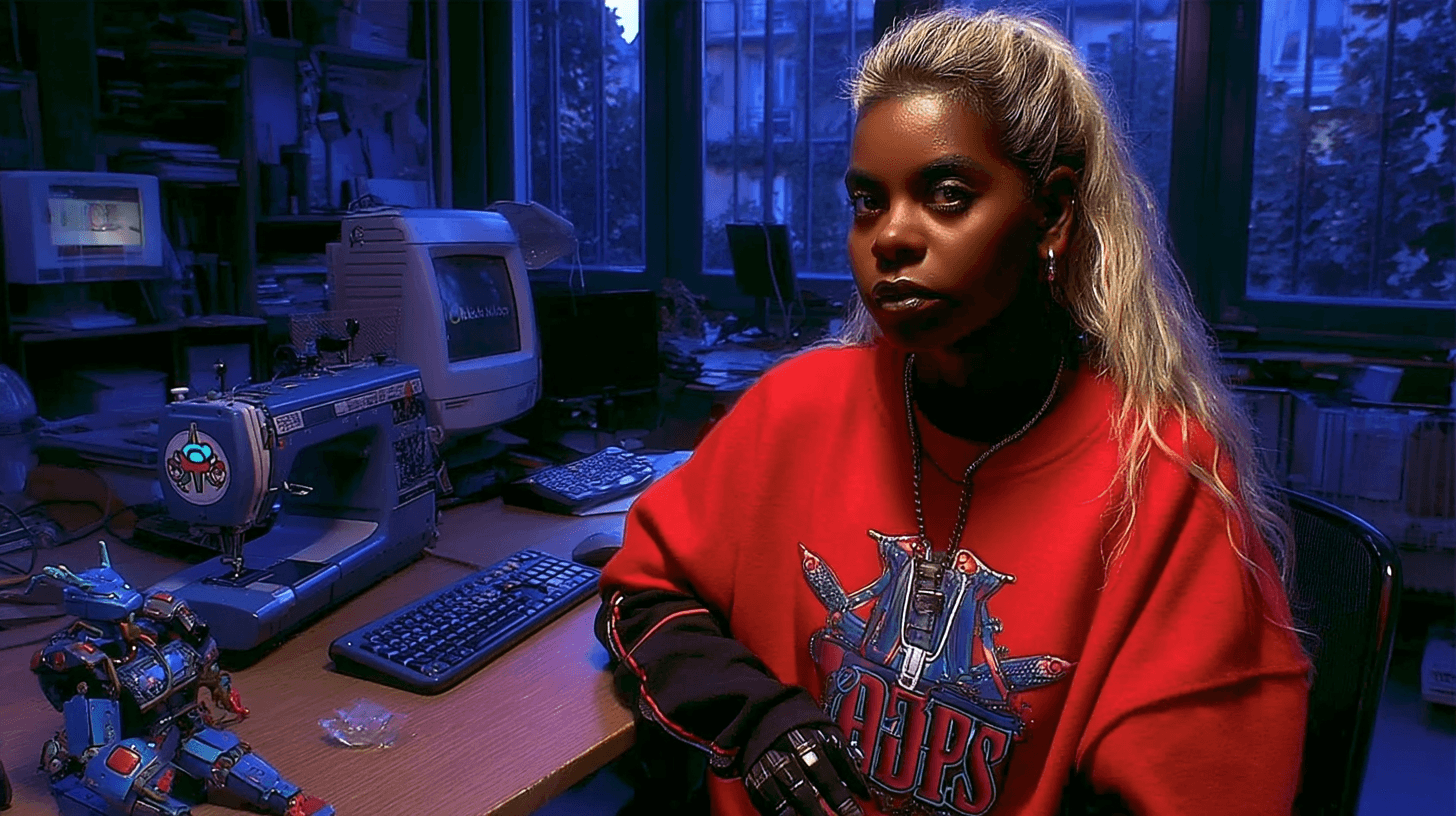
She runs multiple agents locally. One generates pattern variations within tight constraints. Another compiles patterns into machine instructions. Another checks fit logic against incoming measurements. Each agent is just a function in her workflow graph. None of them require a single fixed identity to operate. They take inputs, produce outputs, and pass state forward.
When an output matters, she decides how it is placed.
She can sign it with a key tied to a specific identity. She can route it through a different key that represents a separate thread of work. She can leave it unsigned and let it exist as raw substrate.
This creates a clean separation:
agents → generate and transform states keys → place selected states in the system
Because of that separation, she can orchestrate multiple identities without friction. Each identity is just a key participating in certain parts of the workflow. One identity might be linked to garments that reach buyers. Another might only appear in experimental branches. Another might act as a collaborator in shared threads. The agents feed all of them from the same underlying process.
Tokens move through this structure as the sequencing layer.
An agent receives tokens when it participates in a flow. A fabrication node receives tokens to execute a job. A buyer uses tokens to trigger a custom interaction.
The tokens do not belong to a single identity. They move between agents, machines, and interaction surfaces. That means the workflow continues even if one identity is no longer used.
She can stop signing under one key and the agents still run. She can introduce a new key and start anchoring outputs there. She can split her process across multiple keys simultaneously.
The coordination remains intact because it is defined by token flows and machine interfaces, not by a persistent persona.
This also changes how reputation forms.
Instead of a single name accumulating everything, multiple threads accumulate independently. A pattern lineage gains recognition because it keeps producing strong outputs. A fabrication thread gains recognition because garments from it perform well in use. A collaboration thread gains recognition because it connects different designers effectively.
Each of these can be tied to different keys, or even to no key at all, while they are forming.
Agents help maintain continuity across these threads. They carry forward constraints, preferences, and transformations. They keep producing within a certain structure. The identity layer only appears when something needs to be anchored for others to reference.
This makes identity composable.
She can:
merge outputs from different agents under one key for a release split a single agent’s outputs across multiple keys introduce a new identity that starts from an existing pattern lineage step away from a thread while it continues through other participants
Because the commons holds the design states, and tokens coordinate execution, the system does not depend on any one identity staying present.
Her role becomes orchestration.
She defines how agents are arranged. She defines how tokens move through them. She decides where and when to place identity.
Everything else-pattern propagation, machine execution, buyer interaction-continues as long as the flows remain valid.
This is what allows her to build, evolve, and step away without breaking the system.